
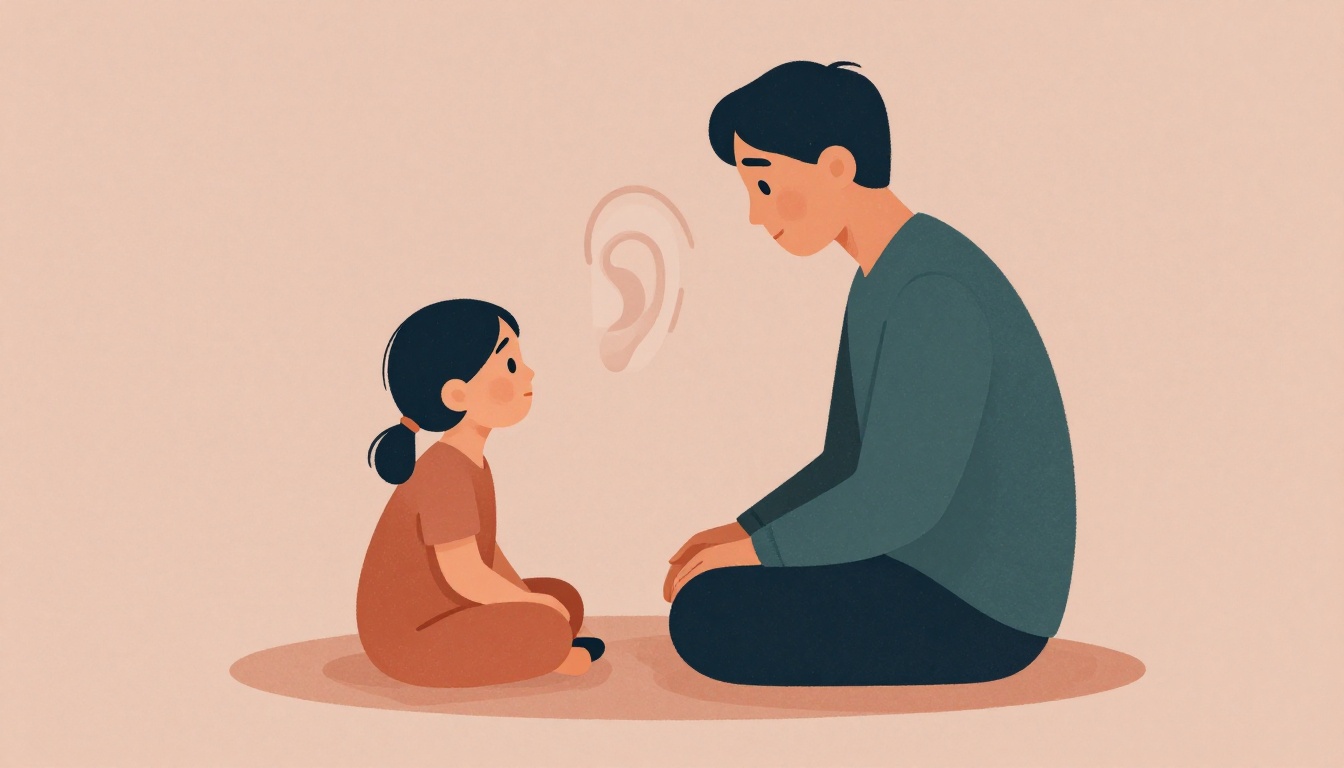
When your child is upset, the urge to fix, teach, or correct can be overwhelming. But kids often don't need a solution—they need to feel heard. Active listening is a specific form of communication that lets your child know you are "with them," aware of what they are saying, and accepting of their perspective. It's the single most important skill in your parenting toolbelt, according to the Center for Parenting Education. When you truly listen, you build trust and help your child develop emotional regulation skills.
Here are practical phrases and steps you can use today to make your child feel truly heard.
Which of the following is a key principle of active listening?
Select one answer.
What active listening looks like
Active listening means giving your full attention to the speaker and trying to understand the complete message being sent. It involves both verbal and nonverbal cues. According to CHOC Children's Hospital, active listening includes eliminating distractions, using verbal and nonverbal language, and asking open-ended questions. It also means getting down to your child's level, making eye contact, and stopping what you're doing.
But the heart of active listening is acceptance. As the Center for Parenting Education explains, acceptance is not the same as agreeing. You can accept that your child feels left out even if you know their statement isn't entirely accurate. Acceptance frees your child to focus on their own feelings and clarify their thoughts.
Phrases that validate and connect
Validation is communicating to your child that you understand how they feel and that their feelings make sense. Here are specific phrases you can use, drawn from child development experts:
- Reflect their words: "I see. You got angry at Bob for knocking over your tower. That must have been very frustrating, I know you worked hard on it." (Woodland Hills Private School)
- Name the feeling: "It sounds like you were frustrated when your brother knocked your blocks down." (Manhattan Psychology Group)
- Show you're listening: "Mmmhmmm," "Oh, I see what you mean." (MyHealth.Alberta.ca)
- Normalize the emotion: "I understand why you feel that way. It's OK to feel that way, and many other kids feel the same." (Mental Health America)
- Summarize and check in: "What I hear you saying is…" or "You would like me to understand…" (SharonSelby.com)
These phrases work because they show your child that their problems are as real to them as yours are to you. Something that seems small to you—like a misplaced sweatshirt—can be a very big deal to your child. Being genuine is key: kids can often tell when adults mean what they say versus just saying the "right words." (MyHealth.Alberta.ca)
How to put it into practice
Follow these steps to turn active listening into a habit:
- Give your full attention. Put down your phone, turn off the TV, and face your child. Make eye contact if possible.
- Get on their level. Sit or kneel so you're at eye height. This nonverbal cue signals that you're fully present.
- Let them talk without interrupting. Resist the urge to jump in with advice or corrections. Let your child finish their thought.
- Reflect and validate. Use phrases like "It sounds like you're feeling…" or "What I hear you saying is…" to show you understand.
- Ask open-ended questions. Instead of "Did you have a good day?" try "What was the best part of your day?" or "How did that make you feel?"
- Avoid fixing too quickly. Remember, acceptance is not the time to object, teach, or solve the problem. Just be with your child in the moment.
Why this matters for your family
Active listening helps kids feel heard and gives them a chance to express themselves without judgment. It strengthens your relationship and helps your child learn to accept and work through their emotions. Over time, this builds self-compassion and resilience. When your child feels understood, they're more likely to come to you with bigger problems later.
Quiz: Test your active listening knowledge
Which of the following is a key principle of active listening?
- A. Acceptance is the same as agreeing with your child.
- B. You should always offer a solution right away.
- C. Acceptance means letting your child know you understand their perspective without judgment.
Correct answer: C. Acceptance is not the same as agreeing; it means acknowledging your child's feelings without judgment.
How the Featured Expert Can Help
The SEL Supply Co provides personalized social and emotional support for families, offering free consultations and customized plans. They focus on areas such as anxiety, behavior, and communication, and operate on an hourly basis. If you want to strengthen your family's communication and emotional health, visit The SEL Supply Co to learn more and book a session.